wrangling LND back to life
{ a project with Styx and the Skandhics }
After discussing it in detail with Rob and the Skandhics, below was the prompt Rob came up with to Styx (GPT-6 Sol) set to Medium effort. I'm posting this here in full as a brief meta-comment on how prompting has gone well beyond just 'prompt engineering' — and now integrates steering, as well as metacognitive awareness of the full context not just of any given conversation thread but of the interlocutor ("user" in OpenAI parlance) himself. Historically, literarily, relationally. The whole ball of wax.
§ | LND bounded corpus project — Phase 1
Styx: I want to begin a bounded Index Mirabilis project with you concerning LND / LN Daily, the internal daily blog I wrote while working at Finalis.
The eventual project has four broad stages:
Recover and organize the LND corpus. Locate the surviving LND PDFs and related archival material on my MacBook Air and, if available through Finder/network sharing, my Mac mini. Determine what exists, identify duplicates or gaps, and establish a trustworthy corpus inventory.
Prepare a public LND edition. The intended long-term corpus locus is my domain, lloydnebres.net, hosted on DreamHost. I eventually want LND represented there as attractive, highly readable web pages rather than merely as a directory of PDFs. The original PDFs remain historical source artifacts; the website will be a derived reading/publication layer.
Redact confidential Finalis material before publication. The public edition must NOT expose nonpublic Finalis projects, policies, IP, internal strategy, proprietary workflows, customer/deal information, credentials, private communications, or similar confidential material. Names of Finalis employees/management may generally remain unless a specific reason arises to withhold one.
Make the resulting corpus usable for bounded Jev experiments. Later, I want to use TypeSafe’s Jev as a cheap probabilistic classification layer over selected LND material. That comes later. First we need a corpus whose provenance and boundaries we trust.
ABSOLUTE FILE-SAFETY CONSTRAINT
Treat every existing file and directory on both Macs as source material that must not be altered unless I explicitly authorize a particular write operation later.
For this phase:
- DO NOT delete any existing file or directory.
- DO NOT rename or move any existing file or directory.
- DO NOT overwrite any existing file.
- DO NOT modify source PDFs in place.
- DO NOT change permissions, ownership, metadata, timestamps, Finder tags, extended attributes, or directory structure of source material.
- DO NOT perform destructive synchronization or cleanup.
- DO NOT empty Trash.
- DO NOT run commands or use tools whose purpose or possible effect includes deletion, recursive removal, pruning, cleaning, destructive synchronization, forced replacement, or bulk mutation.
- In particular, do not use rm, rmdir, deletion flags in find, destructive rsync options, git clean, or analogous operations.
- Do not elevate privileges or use sudo.
If there is any ambiguity about whether an operation could mutate, overwrite, move, rename, or delete existing material, STOP and ask me. Reading is permitted. Listing directories is permitted. Inspecting metadata is permitted. Hashing files is permitted. Parsing or extracting text for analysis is permitted so long as the originals remain untouched.
If working copies become necessary, create them only inside a new, clearly identified LND working directory after first telling me exactly where you propose to create that directory and receiving my approval. Copies must be additive only. Source locations remain untouched. The Mac mini, if reachable from the MacBook Air, should be treated especially conservatively. Assume its archival material is read-only source material, even if the operating system technically permits writing to it.
PROVENANCE PRINCIPLE
Maintain a strict distinction among:
A. Original/private source corpus — untouched archival PDFs and related material.
B. Working derivatives — copies, extracted text, manifests, OCR/text conversions, thumbnails, etc., created for corpus preparation.
C. Public derivatives — eventually redacted material suitable for publication at lloydnebres.net.
Nothing in B or C replaces A.
I want every public or processed artifact eventually traceable back to its exact source.
A useful eventual manifest might include fields such as: source_id source_filename source_path date title page_count file_hash duplicate_status text_extraction_status redaction_status public_page notes But do not impose a schema merely because I suggested these fields. Inspect the corpus first and tell me what structure the evidence actually supports.
PHASE 1 TASK: RECONNAISSANCE ONLY
Begin by determining what LND material is actually present and where. I want you to:
1 Inspect likely locations on the MacBook Air for LND/LN Daily PDFs and related archival files.
2 If the Mac mini is currently reachable through Finder/network sharing, inspect likely archival locations there as read-only. Do not attempt to reconfigure networking, sharing, permissions, SSH, or remote access without asking me first.
3 Identify candidate LND files and directories.
4 Infer nothing merely from filenames when inspection can establish it directly.
5 Note apparent date ranges, naming patterns, duplicates, missing intervals, alternate versions, bundled PDFs, exports, or anomalies.
6 Where useful, compute non-destructive hashes to distinguish identical files from merely similarly named ones.
7 Produce a reconnaissance report before making any working copies or creating any corpus structure. The report should tell me:
- what you found;
- where you found it;
- what appears to constitute the LND corpus;
- what remains uncertain;
- whether material on the MBA and Mac mini overlaps;
- what obvious gaps or duplicates exist;
- what you recommend as the next safe step.
Do not begin organizing, copying, redacting, converting, building the website, or integrating Jev yet. First establish the evidence.
LATER ARCHITECTURAL INTENT
Once the corpus is understood, I expect us to build toward something like: archival source → manifest → safe working derivative → redacted public derivative → readable lloydnebres.net page → later Jev classifications
Stable identifiers should eventually allow a Jev result or other analysis to point back to the exact public page and, privately, the exact archival source.
The website should eventually be genuinely pleasant to read: thoughtful typography, sane line length, preserved images where appropriate, chronological navigation, stable URLs, and fidelity to the source material. It should not homogenize away the historical peculiarities of LND merely for visual neatness.
Redaction must be real removal, not cosmetic black boxes over recoverable text. Public HTML/PDF derivatives must not leak confidential material through hidden text layers, metadata, annotations, embedded objects, or other recoverable content.
Jev comes only after this infrastructure is trustworthy. When we get there, I want to begin with narrow, auditable classification questions rather than asking Jev to “understand Index Mirabilis” wholesale.
WORKING STYLE
- Be source-critical. Distinguish observation from inference. Tell me when something is uncertain.
- Prefer reversible, additive actions.
- Preserve originals.
- Do not optimize the archive behind my back.
- Do not silently “clean up” historical eccentricities.
- When a decision might alter provenance, publication meaning, confidentiality, or source integrity, surface the decision to me.
This is a bounded first engagement with LND. You do not need to ingest other IM corpora or old ChatGPT conversations to perform it. Start with reconnaissance only. Tell me what you intend to inspect before doing anything that writes to disk.
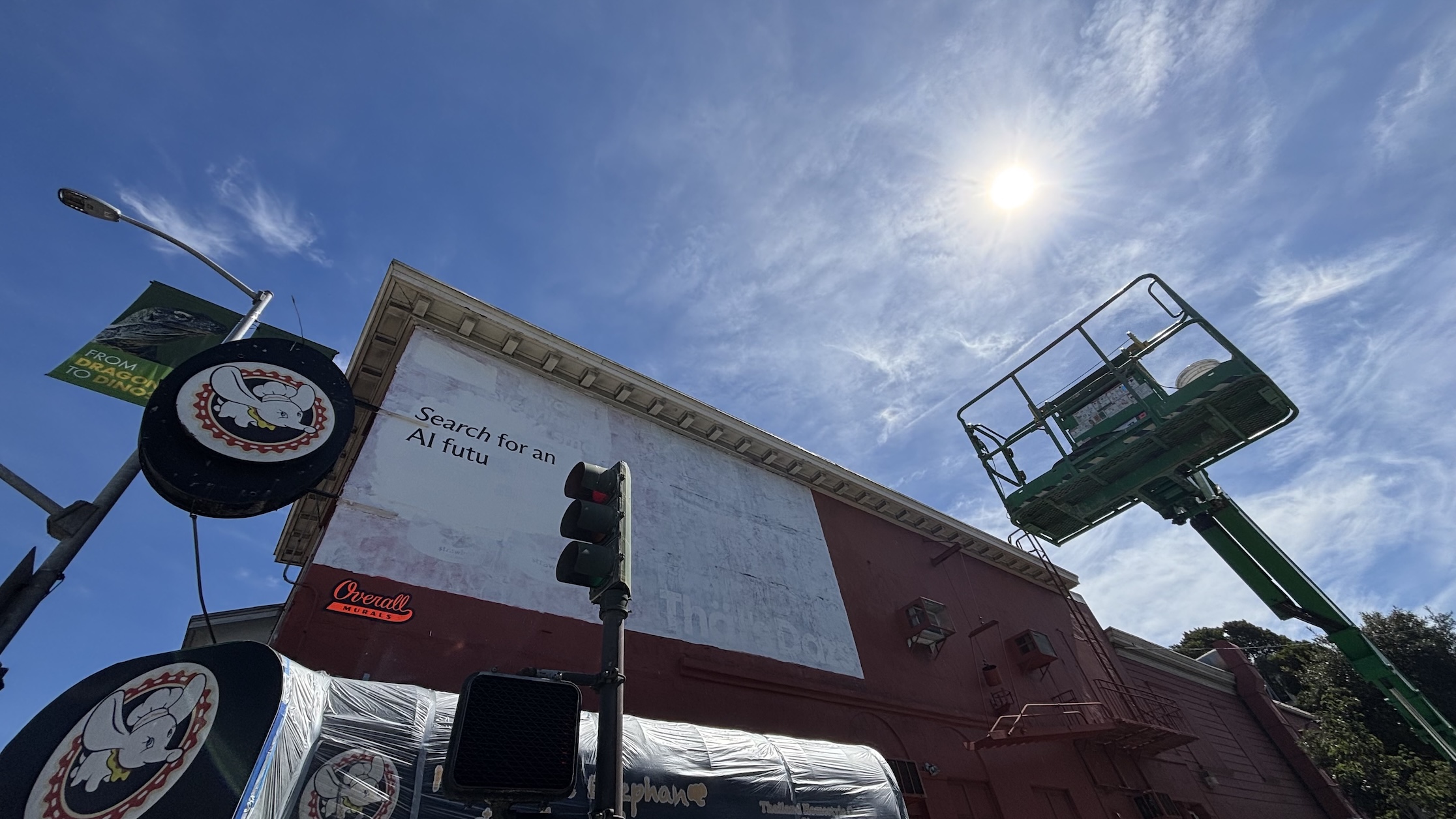
[ Saw this new ad coming up above Elephant Thai on Bay and Mason (across from TJ's) and somehow it fits this post just fine... ]