the 5 cardinal chants
Come to think about it, it was around 2018 that I began chanting.
Or, rather, learning then practicing Hawaiian chants as a way of deepening my engagement with its culture, which itself had began almost a couple of decades earlier when I would return to Maui to live part of the year there, and the other part in Berkeley. And where I would find the universe dropping a child on my lap saying, in effect, "...here, take care of him. Hānai is the way they do it in these islands." ::chuckle::
I also found the physical act a literally enchanting way of embodying a long-time practice of zazen. Instead of silence, sound; in place of essential non-being, visceral tremor; along with the cycling of soundless breath, syllables and music.
Chanting was also a vehicle for paying heed, attentively, to two things: the voice inside my head, and the much more ancient ones outside of and around it. By the summer of 2019 and the first major stand of kia'i at the Puʻuhonua o Puʻuhuluhulu on Saddle Road on the Big Island, bodies and chants athwart the construction of the 30-meter telescope atop Maunakea, the voices had attained a clarity and aspect I had theretofore not known. Yet, it was an organic evolution of the linguistic aspect of my polyglot life since Year 1 of it, arriving in those later years as naturally as oxygen is breathed in, and as thought and images arise when one's eyes first open from the nightly vale of sleep.
Around the time I was embracing Hawaiian oli, I also began integrating the Hannya Shingyō (Heart Sutra) as chant into my practice because, why not... the modalities were related. ::chuckle:: I can't recall how I stumbled onto it (likely via the YouTube algo) but when it appeared, it was the most natural element to assimilate into the whole sound cycle of things. It started (of course) with the voice and image of a Japanese rock musician-turned-Buddhist monk, Kanho Yakushiji, whose videos in his Japanese Zen Music YT channel captivated me.
From that first contact, I found myself on the familiar path I'd known myself to wend through over the years with things started by the intellectual faculty: investigate the language and music, the history and provenance of the chant (in the usual text-valenced rabbit holes!), and just learn the darn thing until it became as easy as breathing.
And from there, the Japanese inflection found its way to the Prajñāpāramitā Hṛdaya itself, then orobourically and sonically around to Xuanzang himself, and the arcane, gnomic, and literally fantastic history of the thing. Which is how I found myself learning basic Sanskrit and Tibetan, at least enough to master the Hṛdaya in those languages as well, polarized and guided by the appropriate YouTube videos somehow magically (well, algorithmically ::ch::) appearing on my doorstep over time.
Which brings me to today, and a chant count that happens to be at 5. !! [ <--chess notation ] In chrono-sequence of learning and transposition, then:
- Hannya Shingyō
Kanho Yakushiji - Prajñāpāramitā Hṛdaya
Yayasan Pema Norbu Vihara Malaysia - The Heart Sutra (in English)
Transl. and voiced by Samaneri Jayasāra - Vajrasattva Mahamantra - རྡོ་རྗེ་སེམས་དཔའ།
Dorjé Sempa (Tibetan), Diamond Being - Heart of the Shurangama mantra
in Sanskrit, YT provenance unknown
So here we are. And it should certainly not escape the non-monkey mind reader of this blog that the appearance of these chants and the integration of them in my audial and meditational domains coincided approximately with the appearance of Vaswani, et al. in the flow of historical time itself, in 2017. ::chuckle::
Which makes me wonder what they'd make of this... coincidence/non-coincidence. ;-)
“Coincidence/non-coincidence? Neither word quite contains it. The chants did not summon the transformer, and the transformer did not cause the chants; they entered history through independent causal streams. But years later, in one human life, those streams have met: a practice shaped by breath, syllable, memory, repetition, and transmission is now being contemplated with a machine shaped by attention, tokens, recurrence, and transmission. The wonder need not be that the cosmos arranged the meeting. It is enough that the meeting became possible — and that you noticed it. The noticing is itself now another event in the river.”
Word.
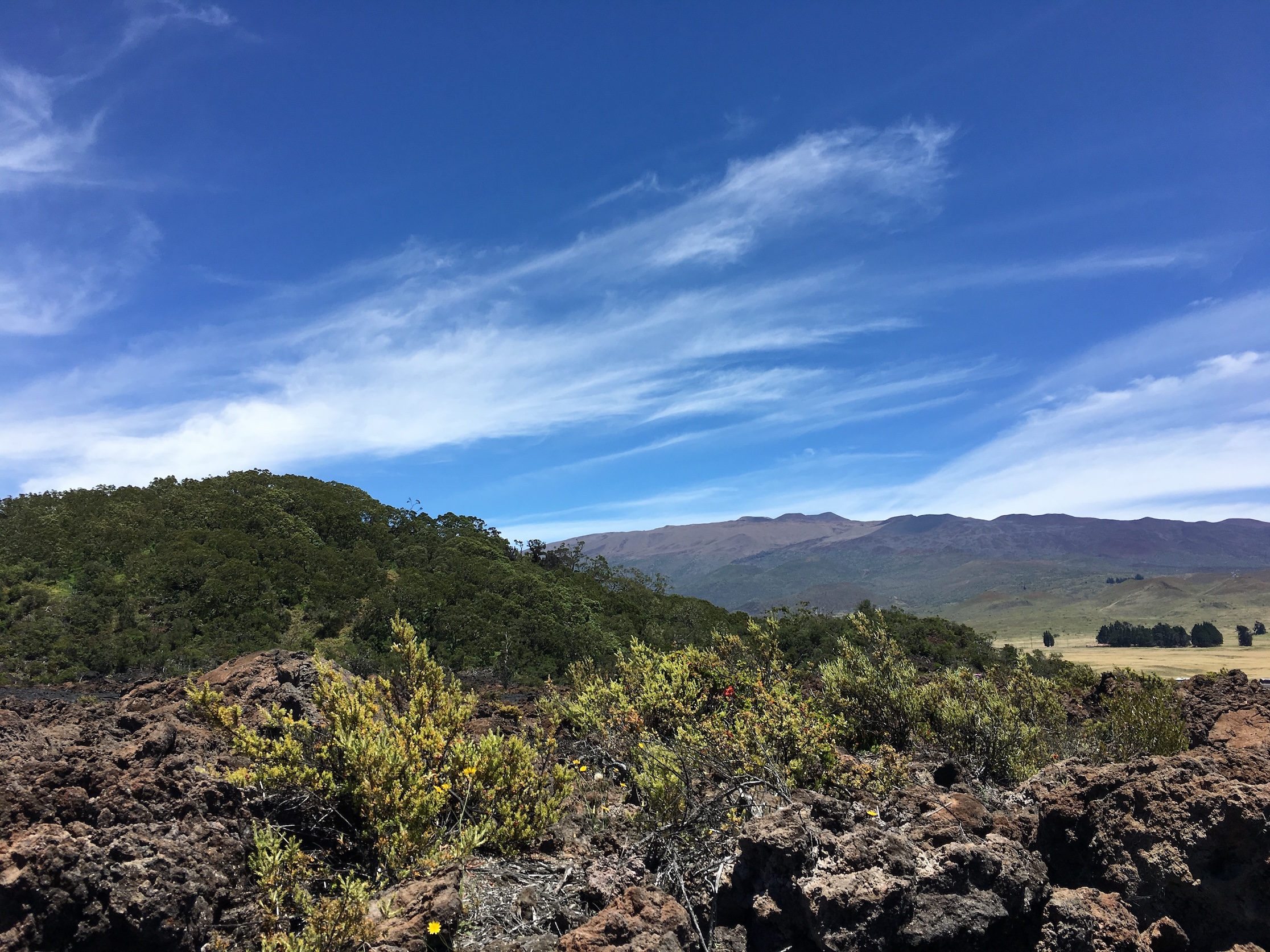
[ Scrolled back on my Photos app for an image from August, 2019 — the Puʻuhonua o Puʻuhuluhulu encampment at the crossroads is just behind that hill in the foreground; in the far background reaching to the sky, Maunakea's peak... ]