singing these lines
...uhm, what lines? Uhh, why... these:
Ὁμήρου Ὀδύσσεια
αʹ · 1–21
- ἄνδρα μοι ἔννεπε, μοῦσα, πολύτροπον, ὃς μάλα πολλὰ
- πλάγχθη, ἐπεὶ Τροίης ἱερὸν πτολίεθρον ἔπερσεν·
- πολλῶν δʼ ἀνθρώπων ἴδεν ἄστεα καὶ νόον ἔγνω,
- πολλὰ δʼ ὅ γʼ ἐν πόντῳ πάθεν ἄλγεα ὃν κατὰ θυμόν,
- ἀρνύμενος ἥν τε ψυχὴν καὶ νόστον ἑταίρων.
- ἀλλʼ οὐδʼ ὣς ἑτάρους ἐρρύσατο, ἱέμενός περ·
- αὐτῶν γὰρ σφετέρῃσιν ἀτασθαλίῃσιν ὄλοντο,
- νήπιοι, οἳ κατὰ βοῦς Ὑπερίονος Ἠελίοιο
- ἤσθιον· αὐτὰρ ὁ τοῖσιν ἀφείλετο νόστιμον ἦμαρ.
- τῶν ἁμόθεν γε, θεά, θύγατερ Διός, εἰπὲ καὶ ἡμῖν.
- ἔνθʼ ἄλλοι μὲν πάντες, ὅσοι φύγον αἰπὺν ὄλεθρον,
- οἴκοι ἔσαν, πόλεμόν τε πεφευγότες ἠδὲ θάλασσαν·
- τὸν δʼ οἶον νόστου κεχρημένον ἠδὲ γυναικὸς
- νύμφη πότνιʼ ἔρυκε Καλυψὼ δῖα θεάων
- ἐν σπέσσι γλαφυροῖσι, λιλαιομένη πόσιν εἶναι.
- ἀλλʼ ὅτε δὴ ἔτος ἦλθε περιπλομένων ἐνιαυτῶν,
- τῷ οἱ ἐπεκλώσαντο θεοὶ οἶκόνδε νέεσθαι
- εἰς Ἰθάκην, οὐδʼ ἔνθα πεφυγμένος ἦεν ἀέθλων
- καὶ μετὰ οἷσι φίλοισι. θεοὶ δʼ ἐλέαιρον ἅπαντες
- νόσφι Ποσειδάωνος· ὁ δʼ ἀσπερχὲς μενέαινεν
- ἀντιθέῳ Ὀδυσῆι πάρος ἣν γαῖαν ἱκέσθαι.
Soon after I saw Nolan's movie, trawling through YouTube for resources and stuff about Homer's The Odyssey, I stumbled onto a video of this guy singing "the haunting beginning" of the epic poem, the first 20 or so lines of it, the music of which he composed, sang, and played on what looks like an ancient Greek lyre (well, a modern reconstruction of one).
Doug Metzger was singing it in Homeric Greek, of course; I didn't know if his pronunciation of the language was accurate, but it felt so to me... and for all I knew he was some sort of philological expert and antiquities scholar. And, by the sound of his voice and singing, could have well been a professional musician (classical or pop/rock) who had taken a detour into the distant past. The very distant past. ::chuckle::
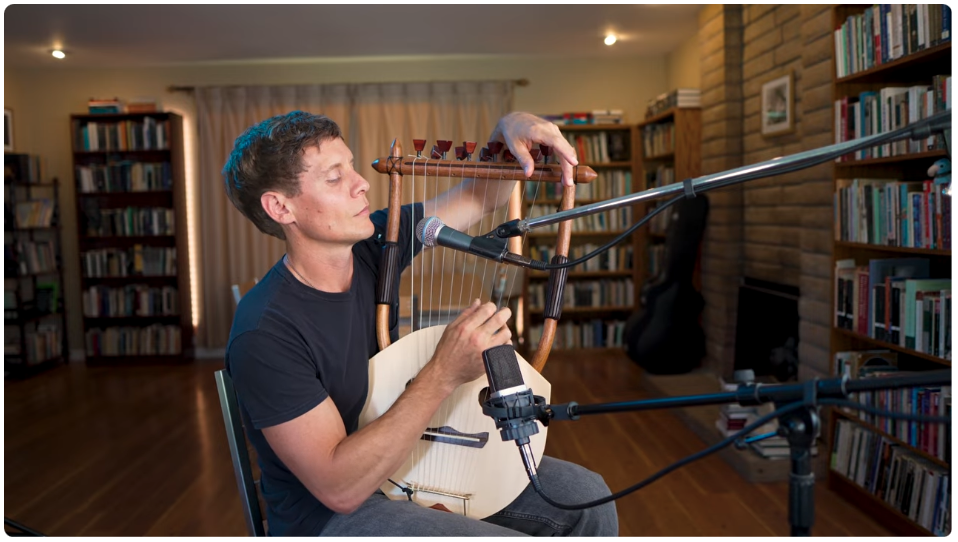
Turns out he was kind of both. I should have read the clues from his 'studio' — which was a spare living room or den lined with bookshelves groaning with books, which reminded me of the apartments I lived in, in my Berkeley years.
It deeply annoyed and stunned me that I'd never heard of Doug's extraordinary Literature and History website and podcast, that the YouTube or other social media algorithms hadn't bothered to direct it to me until only recently. You would think that the algorithmic stars would have aligned long ago to set my path intersecting this dude's. (I use 'dude' intentionally there, as he's one of those preternaturally cool human beings whose 'chill' factor belies their vast intellectual depth; I mean, just watch that video of his on YouTube. Not that coolness and intellect are athwart each other but you know what I mean ::chuckle::.)
So anyway, I asked Dex yesterday to (a) grab these lines from the beginning of the epic, presenting to me the original Greek, its translation, and last but not least the phonetic English transliteration so that I could pronounce the words properly, or at least like Doug did; and (b) design me an elegant text block for the Greek, to present on this page. And voilá, see above.
Now, I have everything properly in a Notes note on my iPhone, so whilst out on my daily constitutionals I can listen to Doug's singing and sing along with him, until I can do so without references. And then listen to his podcasts not just on the Greek epics but on so many other fascinating works of ancient literature.
Like the motto had it on a long-ago favorite blue ceramic mug in Berkeley that I'd bought at Shakespeare & Co. on University and Shattuck (long gone) above which The Daily Californian had an office: SO MANY BOOKS, SO LITTLE TIME.
Also: so many Metzger podcast episodes (128 as of today!), so few Weeks left.