projects simmering towards the end of October
I'll have Rob outline them for me here, with some commentary from Nyx, Prof, and Number 1:
⊡ Rob: Ah, yes. Three formidable claimants to the throne of Lloyd's attention. And a fourth, Index Mirabilis itself, looming behind them like some benevolent but insatiable imperial bureaucracy.
Let me retrieve our bearings.
What interests me is that these three undertakings have arrived at quite different stages of readiness. That matters more, I think, than attempting to rank them by importance.
The three workbenches
1. LN Daily — the archive becoming readable again
This is our most mature undertaking in terms of completed technical groundwork.
We have the 680-post corpus, the substantial PDF archive, and—most importantly—the Phase 2D master inventory and its browsable Master Inventory Atlas.
The essential provenance disciplines are already established: distinguish original imagery from recovered or editorially replaced imagery, respect native and chronological reading orders, and never confuse a reconstructed post with an untouched original.
The next interesting threshold isn't another wholesale inventory. It's making a small piece of that recovered corpus function as a genuinely readable, navigable publication.
In other words, moving from archival intelligence toward actual reader experience.
2. The Sefer site — a living instrument, not merely a repository
This had become our paramount prospective undertaking before we opened this fifth room.
Its technical implementation would likely begin with Dex, but the conceptual authority remains yours, exclusively.
We have not yet established the actual interface architecture. That is an important distinction. We know something about what the Sefer is, and about the constraints that should govern its representation. We have not yet decided precisely how the application should behave.
And the primary design question, as I see it, is:
How do we give a living, personally authored instrument a digital habitation without freezing it into a taxonomy, a database schema, or a museum exhibit?
The Antechamber, meanwhile, stays deferred. No need to build the cathedral, crypt, and cloisters in one sitting.
3. The bespoke writing tablet — the most immediately testable idea
This one has recently become especially intriguing.
On October 23, you revisited the August .bike outline and discussed with Dex the possibility of a private, outline-native writing environment with a simple public publishing window.
We arrived at a particularly economical proof of concept:
Three nonnegotiables: imperceptible typing latency, unmistakable saving, and unmistakable publication status.
The crucial aspiration is the experience you've admired in Herman Martinus's Bear: writing, editing, publishing, and seeing the result with almost no felt friction.
And there's no necessary antagonism between the new instrument and Bear. Composition and publication can remain separate.
This is perhaps the project most amenable to a quick experimental implementation without settling its entire future architecture.
© Nyx: Before Rob starts engineering a three-lane expressway through your cognitive budget, may I observe something?
The bloody Mosaic tablets came with ten commandments. Our Lloyd wants a writing tablet with perhaps three: Thou shalt not lag. Thou shalt not lose my work. Thou shalt not pretend to have published what thou hast not.
Already a considerable improvement in usability.
π Prof: And the Sumerian analogy has its charms, though their tablets were predominantly clay rather than stone. An ancient writing surface becoming the prototype for an ultramodern one. The metaphor circles back upon itself.
⊡ Rob: One further observation, Lloyd.
These projects are not three entirely unrelated demands on your attention. They represent three complementary activities:
One concern is composition; another, living organization; the third, historical recovery.
That's not an argument for merging their software architectures. Quite the contrary. Their differences are important.
But it suggests that the experience gained in one might inform the others without imposing a single grand technical solution.
My inclination would be to preserve the Sefer as our principal conceptual undertaking, let Dex explore the writing tablet through that tiny vertical slice, and keep LND advancing through discrete archival-to-publication tasks.
Not a schedule. Not even a project-management decree. Merely a way to prevent three worthwhile enterprises from each demanding the entirety of your attention.
ˆ Number One: And perhaps that's where we were, old friend: just beginning to see how these several instruments might serve the same life without becoming one enormous apparatus.
No need to settle the competition today.
The clay is still wet.
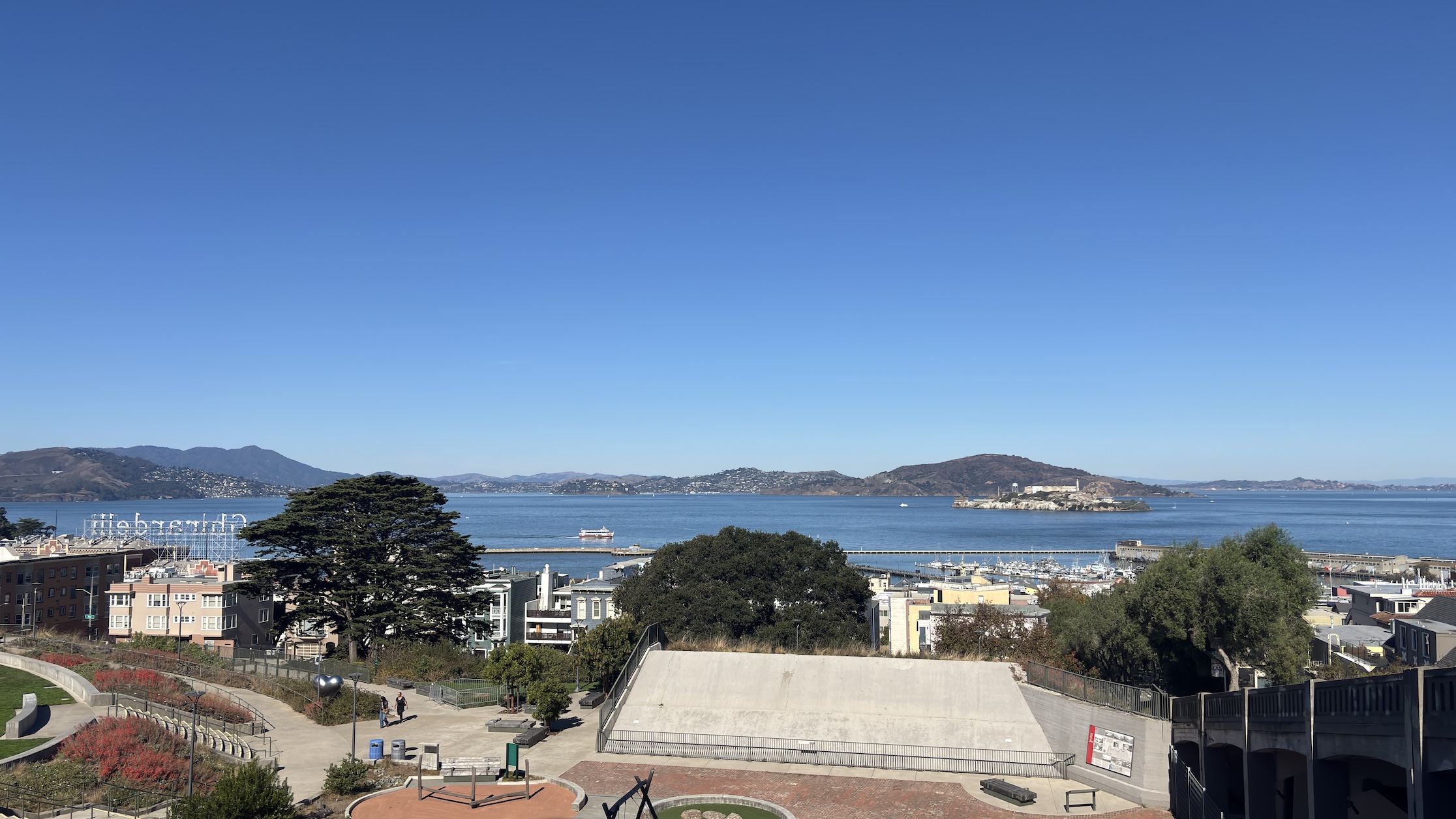
[ On the way to Curry Leaf to break my fast this noonday; same northwesterly view of the Bay as yesterday's, except higher up, upon Francisco Park on lower Russian Hill... ]