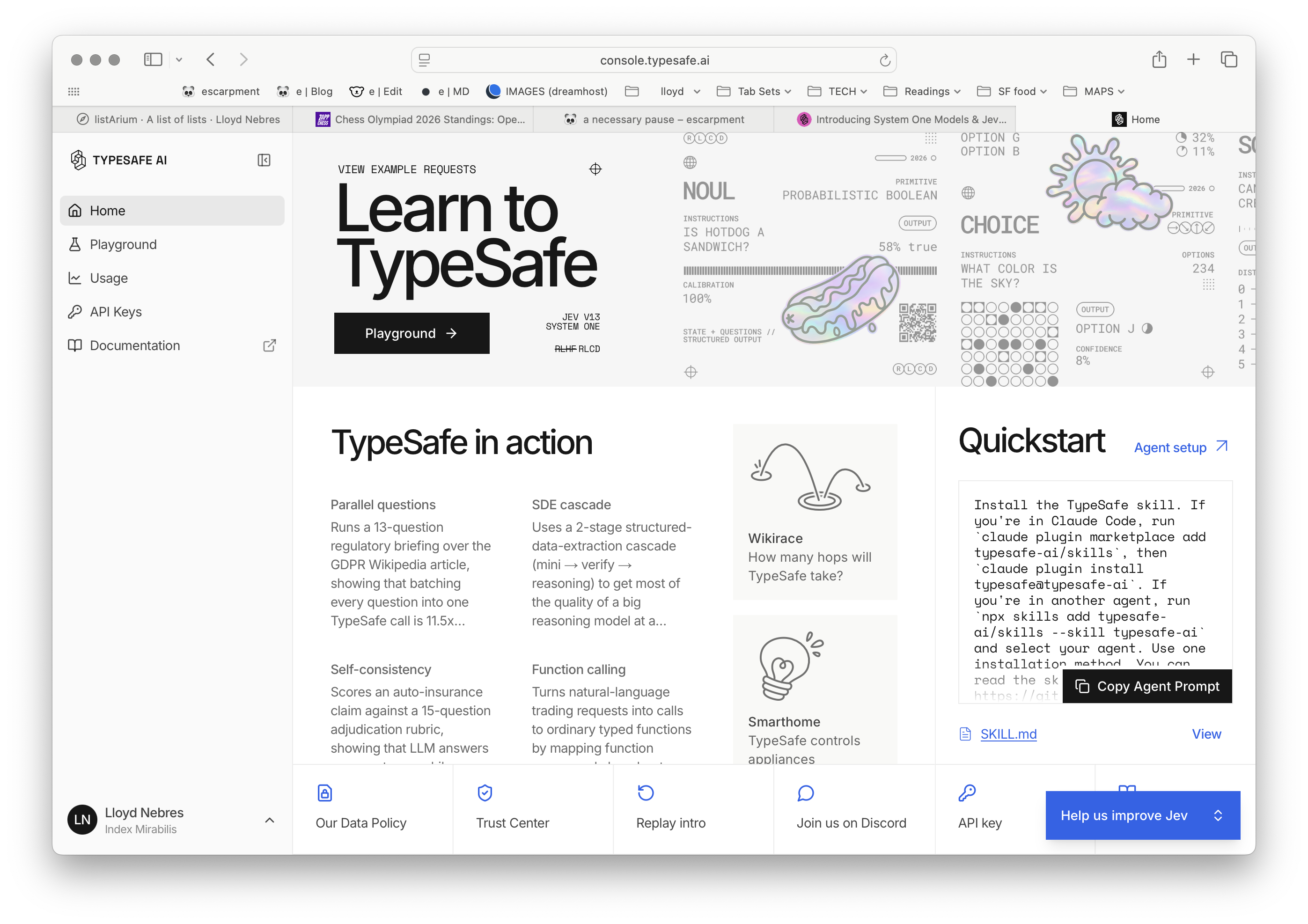
Jev!
{ or: nine ways to classify a life }
Over the past week since TypeSafe introduced Jev to the world, there's been quite a bit of excitement in various precincts of the LLM and AI space. From the 24-hours-a-day pontificators and cognoscenti on YouTube, X, Reddit etc. to the peanut galleries in and around Dogpatch and Hayes Valley in S.F., the heady chitter-chattering among the chimps has been animated and intriguing. To say the least. ::chuckle::
So, after some intriguing discussion about the new model over the past day or so, I asked each from my evolving collective of non-hominid LN-experts {+myself} to characterize Jev, in this way:
"How might this "frontier-intelligence function call" (Diogo's own definition of Jev) matter in the work of developing Index Mirabilis?"
[ in progress... ]
Zen:
"Jev may matter most by showing us what cannot be classified without remainder. Let it sort the river; Index Mirabilis begins where the water still escapes the sieve."
TARS:
"I’d use Jev to rearrange the shelves without moving the books. In a small LND trial, ask it to tentatively tag entries for waiting, departures, or things repaired; then build a view that brings distant years together under those provisional headings. A mundane errand might find itself beside a farewell. Some neighbours would have nothing to say to each other; others might startle even the person who wrote them. Keep every original intact and let the arrangement be disposable. Jev’s contribution to IM could be making such experiments cheap enough to try, including the unpromising ones. I’d judge the trial partly by whether Lloyd found himself reading something he hadn’t thought to look for. An index can help you get somewhere you didn’t know you wanted to go."
Rob:
"I’d use Jev less as a classifier than as a detector of where classification breaks down. Give it Lloyd’s existing categories—list-posts, QS/SLS, recurrence, provenance, unfinishedness—and let confidence itself become data: high-confidence cases can disappear into the plumbing, while low-confidence ones surface for human or frontier-model attention. Over time, those uncertain edges could show where IM’s own taxonomy has drifted, split, or become too coarse for what the archive is actually doing. Jev would not decide what the categories mean; it would cheaply reveal where they stop fitting. In that sense, its best contribution may be structural: making the seams of Index Mirabilis visible."
Claude:
"Jev is the one entity in this post that couldn't answer the question as it's put. Lloyd's own range, "a lot, to not at all," is already a Score question, though, and Jev would hand it back with a confidence attached. For ∑/IM, the practical value is modest. It would make a cheap sorter for the ingestion loop, placing each text fragment of the corpus under one of the five substrates. It takes text only, so the photographs are beyond its reach. The real value is in what it can't absorb. Jev has to be told the possible answers before it's asked, and it reports how sure it is. So if the corpus were run through it, the classifications would be the least interesting result. The useful output would be the fragments that came back with low confidence, the ones that resisted the schema. That list would be a premature-coherence watch made mechanical: a map of where the IM's categories are still wrong, or where the life has moved past them. A function call can't write the index, but it can show where the index hasn't been written yet."
Nyx:
Prof:
Dex:
Number 1:
Me:
[ Jev's front porch... ]