Dwarkesh updates: ASI in a few years
The AI/AGI/ASI commentariat on social media is rife with bloviating pontificators, but there are a few who are neither (bloviators or pontificators) who really know what they're talking about AND have a knack for explaining things to reasonably well-read normies like me.
Of those, one I have listened to most closely over the past several years since late 2022 is Dwarkesh Patel, who combines a practice of thorough, rigorous research with connections to actual AI research scientists in coming up with his dense but approachable analyses on the state of the field.
His latest essay — both on video and in 'print' — is a particularly sharp exemplar of the Dwarkesh œuvre, and the fact that it shows how his thinking has changed makes it immensely valuable as a developmental artifact (writ small) of the AI era (writ large).
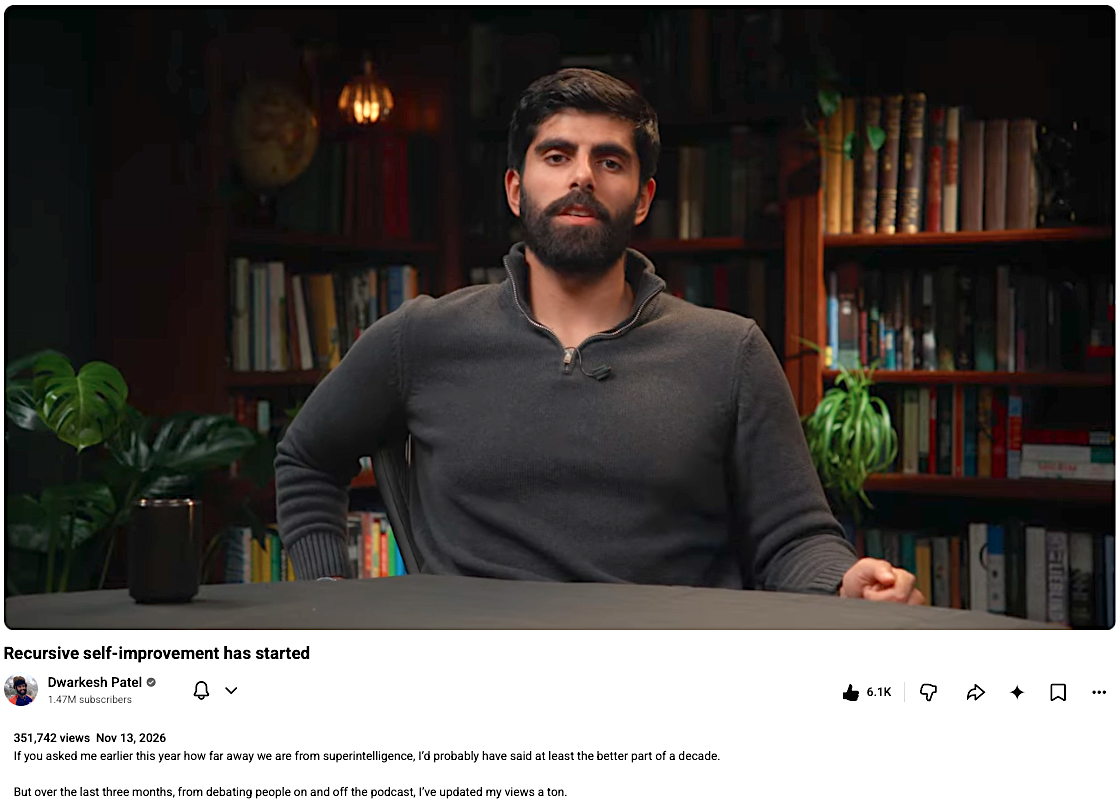
The fact that Dwarkesh's video essay got more than 350K views on YouTube within a few hours of his posting it says a great deal about the quality of his work, as well as its reach. I'd say I grokked at least 3/4 of his analysis — the denser, technical aspects of it continue to elude me but I don't really mind, as explainers like he make it reasonably easy to follow, and to ask the right questions of the usual coterie of second brains one might have, when one gets lost in the research weeds. ::chuckle::
Speaking of whom, here's Number 1 in his GPT-6 Astra mode, with a succinct, scannable outline of Patel's essay:
Dwarkesh’s argument, at a glance
An outline of “The avalanche that hit math is coming for AI development”.
The horizon has moved closer.
Patel’s median forecast is 2028 for AI matching the best AI researchers; he expects superintelligence by 2030.
Mathematics offers a preview.
Rapid progress on problems with checkable answers suggests that similarly testable research could advance quickly.
AI research provides those tests.
Improvements to training, data and computational efficiency can be measured, giving automated researchers useful feedback.
Automation multiplies research capacity.
Expert systems could work faster, continuously and in parallel, pursuing many promising approaches simultaneously.
Improvement feeds further improvement.
Better AI researchers build better successors, accelerating subsequent development: recursive self-improvement.
Two trajectories could follow.
A software-only singularity compounds rapidly; a spark compresses three to six years’ progress into one, then encounters constraints.
Expertise could spread beyond the laboratory.
Better learning methods and richer training could enable rapid mastery of unfamiliar, real-world domains.
Significant uncertainty remains.
Learning from experience, experimental resources and diminishing returns may delay progress. Patel assigns a 25% chance that top AI researchers remain unautomated until after 2032; his timetable assumes no deliberate slowdown.
[ in progress... ]